DNS-PERSIST-01 Explained: Set It Once, Renew Forever
The new ACME validation method that eliminates DNS changes from your certificate lifecycle. Approved by CA/Browser Forum (SC-088v3), with Let's Encrypt support rolling out in 2026.
Not sure which DCV method is right for your infrastructure? The PKI Priority Planner analyzes your environment and tells you what to focus on first.
Assess Your PrioritiesWatch the Video
The Problem DNS-PERSIST-01 Solves
If you've automated certificate issuance with DNS-01 validation, you already know the pain points. Every renewal cycle requires your ACME client to create a new TXT record, wait for DNS propagation, and clean up afterwards. At scale, this creates real operational friction:
Credential distribution
DNS API credentials scattered across your issuance pipeline — every server that renews needs write access to your zone
Propagation delays
Every renewal waits for DNS propagation, adding minutes (or longer) to each issuance cycle
Concurrent validation issues
Multiple servers validating the same domain can overwrite each other's challenge tokens
Change management friction
In enterprise environments, DNS changes often require approval workflows — for every single renewal
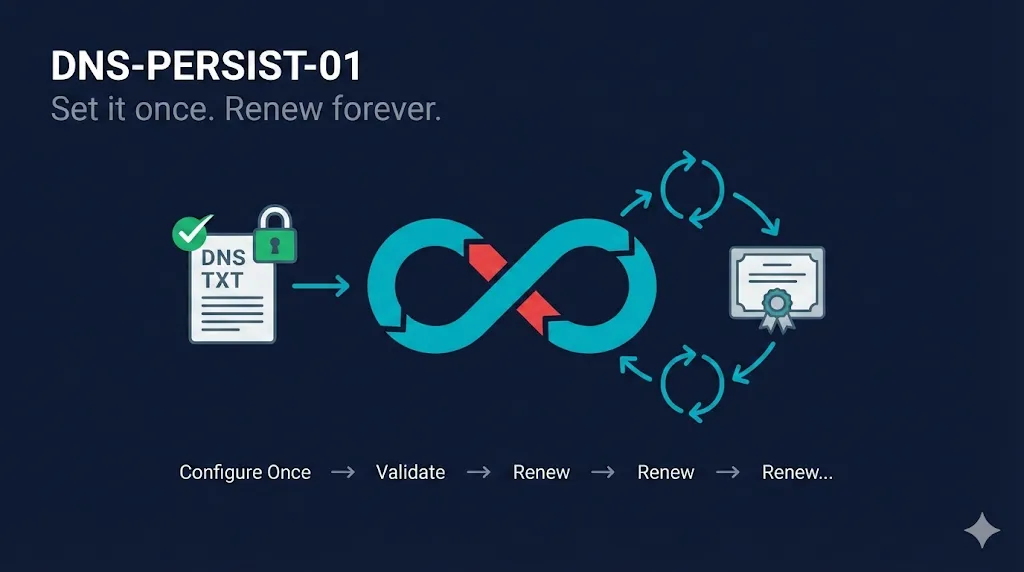
DNS-PERSIST-01 takes a fundamentally different approach. Instead of repeating the challenge-response dance on every renewal, you publish a single, persistent authorization record. Set it once, and renewals just work — no DNS changes needed.
How DNS-PERSIST-01 Works
The key insight: instead of proving domain control on every issuance via a fresh challenge token, you publish a standing authorization that says "this CA, using this specific ACME account, is authorized to issue certificates for this domain."
The DNS Record
_validation-persist.example.com. IN TXT (
  "letsencrypt.org;"
  " accounturi=https://acme-v02.api.letsencrypt.org/acme/acct/1234567890"
)
Breaking Down Each Component
_validation-persistThe DNS label — replaces _acme-challenge from DNS-01. This is a fixed prefix, not configurable.
letsencrypt.orgThe CA's issuer-domain-name — identifies which Certificate Authority this record authorizes. Each CA has its own identifier.
accounturi=...Binds the authorization to a specific ACME account — not just "anyone using this CA" but specifically YOUR account. This is mandatory.
DNS-01 Flow (Every Renewal)
- 1.Request certificate
- 2.Generate challenge token
- 3.Update DNS TXT record
- 4.Wait for propagation
- 5.CA validates
- 6.Certificate issued
- 7.Repeat everything on next renewal
DNS-PERSIST-01 Flow
- 1.Set TXT record once
- 2.Request certificate
- 3.CA validates (reads existing record)
- 4.Certificate issued
- Renew → Renew → Renew... no DNS changes needed
DNS-01 vs DNS-PERSIST-01 — Head-to-Head
| Feature | DNS-01 | DNS-PERSIST-01 |
|---|---|---|
| DNS changes per issuance | Every time | Once (setup only) |
| Challenge type | Fresh token per request | Persistent standing authorization |
| DNS label | _acme-challenge | _validation-persist |
| Wildcard support | ✅ Yes | ✅ Yes (with policy=wildcard) |
| DNS API credentials at renewal | ✅ Yes — in the pipeline | ❌ No — only during setup |
| Propagation delays at renewal | ✅ Yes | ❌ No |
| Concurrent validation safe | ❌ No | ✅ Yes |
| CA binding | Per-challenge only | Persistent, account-scoped |
| Security focus | Protect DNS write access | Protect ACME account key |
| Revocation method | Stop updating DNS | Remove TXT record or deactivate ACME account |
| CA/B Forum section | 3.2.2.4.7 | 3.2.2.4.22 |
| Validation data reuse | Per CA policy | Max 10 days (per BRs), subject to TTL |
| Let's Encrypt status | Production ✅ | Staging late Q1 2026, Production Q2 2026 |
Scope Controls — Wildcard, Subdomains, and Expiration
Basic FQDN Only (Default)
No policy parameter means authorization for the exact domain only.
_validation-persist.example.com. IN TXT (
  "letsencrypt.org;"
  " accounturi=https://acme-v02.api.letsencrypt.org/acme/acct/1234567890"
)
Covers: example.com only.
Wildcard + Subdomains
Add policy=wildcard to extend scope to all subdomains:
_validation-persist.example.com. IN TXT (
  "letsencrypt.org;"
  " accounturi=https://acme-v02.api.letsencrypt.org/acme/acct/1234567890;"
  " policy=wildcard"
)
Covers: example.com, *.example.com, www.example.com, app.example.com, server.dept.example.com — any subdomain.
Optional Expiration (persistUntil)
Add a UNIX timestamp to limit how long the authorization is valid:
_validation-persist.example.com. IN TXT (
  "letsencrypt.org;"
  " accounturi=https://acme-v02.api.letsencrypt.org/acme/acct/1234567890;"
  " persistUntil=1767225600"
)
After the timestamp passes, the CA will not use this record for new validations.
Watch out for silent renewal failures
If you use persistUntil, you MUST monitor and update the record before it expires. Otherwise, your next renewal will fail silently. Consider whether the operational overhead of managing expiration defeats the purpose of "set it once."
Multiple CAs
Authorize more than one CA by adding multiple TXT records at the same label:
_validation-persist.example.com. IN TXT (
  "letsencrypt.org;"
  " accounturi=https://acme-v02.api.letsencrypt.org/acme/acct/123;"
  " policy=wildcard"
)
_validation-persist.example.com. IN TXT (
  "ca2.example;"
  " accounturi=https://ca2.example/acme/acct/456;"
  " persistUntil=1767225600"
)
Each CA only evaluates the records matching its own issuer-domain-name.
Security Tradeoffs — What Changes
Critical framing: DNS-PERSIST-01 doesn't eliminate risk — it shifts where the risk lives. Your primary asset to protect changes from DNS write credentials to your ACME account private key.
The Security Shift
| Scenario | DNS-01 | DNS-PERSIST-01 |
|---|---|---|
| Primary asset to protect | DNS write access (credentials in pipeline) | ACME account private key |
| Attack window | Brief (during each validation) | Persistent (as long as record exists) |
| If attacker compromises DNS | Can get certs during validation window | Can add persistent authorization |
| If attacker compromises ACME key | Limited to one validation cycle | Can use ALL existing persistent authorizations |
| Revocation speed | Remove DNS token | Remove TXT record AND/OR deactivate ACME account |
Best Practices
Treat your ACME account key like a CA signing key
It now persistently authorizes certificate issuance for all domains with a _validation-persist record.
Use policy=wildcard sparingly
Only when you genuinely need subdomain coverage. Default FQDN-only scope limits blast radius.
Monitor your _validation-persist records
Unauthorized additions = unauthorized certificate issuance capability. Include these in your DNS monitoring.
DNSSEC recommended
Cryptographic authentication of DNS records adds integrity protection to your persistent authorizations.
Account key rotation doesn't break records
The accounturi is stable across key rotations (RFC 8555 §7.3.5) — you can rotate without updating DNS.
Know your revocation playbook
To emergency-revoke, deactivate the ACME account (RFC 8555 §7.5.2) — this is immediate and irrevocable.
Implementation Timeline
CA/B Forum Ballot SC-088v3 passes unanimously
IETF ACME WG adopts draft-ietf-acme-dns-persist-00
Let's Encrypt announces DNS-PERSIST-01 support
Pebble (test CA) support available
Let's Encrypt staging environment
Let's Encrypt production rollout
ACME client support (certbot, lego, acme.sh, etc.)
Making a decision right now? The PKI Priority Planner scores your environment and recommends which validation method to adopt — including whether DNS-PERSIST-01 fits your setup.
Assess Your PrioritiesWhen Should You Use DNS-PERSIST-01?
Use DNS-PERSIST-01 when:
- Your servers aren't exposed to the public internet (private infrastructure, geo-locked access)
- You have strict change management and DNS changes require approval workflows
- You manage a large certificate estate and DNS propagation delays are a bottleneck
- You want wildcard certificates without recurring DNS automation complexity
- You're running IoT or edge deployments that can't coordinate DNS updates in real-time
- You want to keep DNS API credentials OUT of your issuance pipeline
Stick with DNS-01 when:
- You need fresh proof of control for every issuance (regulatory or internal policy requirement)
- Your ACME account key management isn't mature enough for persistent authorization
- You're waiting for your ACME client to add support (check certbot/lego/acme.sh status)
Consider HTTP-01 or TLS-ALPN-01 when:
- Your servers ARE publicly accessible and you don't need wildcards
What's Next — Related Standards
DNS-ACCOUNT-01
Solves concurrent DNS-01 validation by binding challenges to ACME accounts. Different from DNS-PERSIST-01, which eliminates challenges entirely. DNS-ACCOUNT-01 still requires DNS changes on each renewal.
47-Day Certificates (SC-081)
Shorter certificate lifetimes make "set it once" even more valuable — you'll be renewing far more frequently, making the case for persistent validation even stronger.
DCV Methods Sunset (SC-090)
Email and phone-based validation methods are being phased out, making DNS-based methods increasingly important. DNS-PERSIST-01 arrives just as other methods sunset.
References & Further Reading
Let's Encrypt Announcement: DNS-PERSIST-01
Official announcement with implementation timeline and technical details
IETF Draft: draft-ietf-acme-dns-persist-00
The IETF specification defining the DNS-PERSIST-01 challenge type
CA/B Forum Ballot SC-088v3
The ballot that added Section 3.2.2.4.22 to the Baseline Requirements
Baseline Requirements (Section 3.2.2.4.22)
The normative requirements for DNS TXT Record with Persistent Value validation
Related FixMyCert Guides
Automating DNS-01 with DNS APIs
Step-by-step DNS provider API setup for the validation method DNS-PERSIST-01 replaces. Essential reading if you need DNS-01 today.
Which DCV Method Should You Automate?
The full decision framework — DNS-01, HTTP-01, TLS-ALPN-01, and now DNS-PERSIST-01. Find the right method for your infrastructure.
DCV Methods Sunset Timeline
The 11 legacy validation methods being eliminated by 2028. Understand why DNS-based methods are the future.
The PKI Automation Gap
Where certificate automation actually breaks across the 5-stage pipeline — and what DNS-PERSIST-01 fixes in the validation stage.