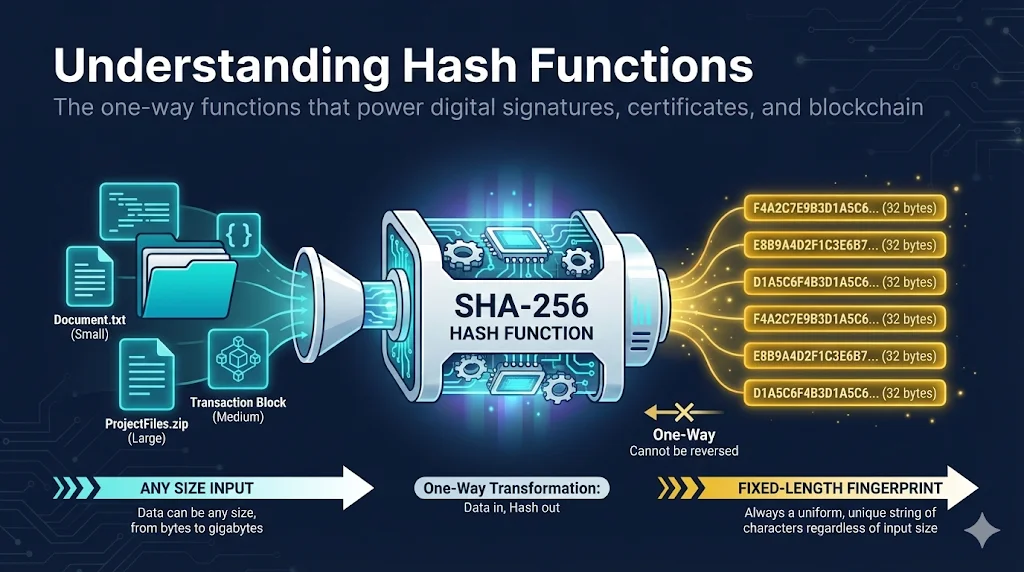
Quick Answer: What is a Hash Function?
A hash function is a mathematical algorithm that transforms any input data into a fixed-size output called a hash,digest, or fingerprint.
Key Properties of Hash Functions
Hashing vs Encryption
Encryption is two-way: you can encrypt and decrypt. Hashing is one-way: once data is hashed, you cannot reverse it. This makes hashing perfect for password storage and data integrity checks.
The Avalanche Effect
A good hash function exhibits the avalanche effect: changing even a single bit of input completely changes the output hash. This makes it impossible to predict how input changes affect the hash.
This property is crucial for security. If small changes produced small hash differences, attackers could work backwards to find the original input. The avalanche effect makes each hash appear completely random and unrelated.
Common Hash Algorithms
| Algorithm | Output Size | Hex Chars | Status |
|---|---|---|---|
| MD5 | 128 bits | 32 | BROKEN |
| SHA-1 | 160 bits | 40 | DEPRECATED |
| SHA-256 | 256 bits | 64 | SECURE |
| SHA-384 | 384 bits | 96 | SECURE |
| SHA-512 | 512 bits | 128 | SECURE |
| SHA-3 | Variable | Variable | LATEST |
Algorithm Security Status
MD5 - Cryptographically Broken
Collisions can be generated in seconds. Never use MD5 for security purposes.It's still sometimes used for non-security checksums, but even this is discouraged.
SHA-1 - Deprecated
Practical collision attacks exist (SHAttered attack, 2017). Most browsers and CAs have stopped accepting SHA-1 certificates. Migrate to SHA-256.
SHA-2 Family (SHA-256/384/512) - Recommended
No known practical attacks. SHA-256 is the current standard for TLS certificates, code signing, and most cryptographic applications.
SHA-3 - Future-Proof Alternative
Based on a completely different design (Keccak). Provides a backup if SHA-2 is ever compromised. Gradually seeing more adoption.
Real-World Use Cases
Websites store hashed passwords instead of plain text. Even if the database is stolen, attackers can't see actual passwords. Modern password hashing uses specialized algorithms like bcrypt, scrypt, or Argon2 that add salt and are intentionally slow.
Software downloads often include a hash. After downloading, you can compute the file's hash and compare it to verify the file wasn't corrupted or tampered with during transfer.
Instead of signing an entire large document, you hash it first, then sign the small hash. This is faster and produces a fixed-size signature regardless of document size.
Cloud storage services hash files to detect duplicates. If two users upload the same file, the system stores it only once, saving space and bandwidth.
OpenSSL Hash Commands
Hash a String
# SHA-256 hash of a string
echo -n "Hello World" | openssl dgst -sha256
# Output: SHA2-256(stdin)= a591a6d40bf420404a011733cfb7b190d62c65bf0bcda32b57b277d9ad9f146e

# MD5 (don't use for security!)
echo -n "Hello World" | openssl dgst -md5
Hash a File
# SHA-256 hash of a file
openssl dgst -sha256 myfile.txt

# Get just the hash (useful for scripts)
openssl dgst -sha256 -r myfile.txt | cut -d' ' -f1

# Compare with published hash
sha256sum myfile.txt
Different Algorithms
# Available hash algorithms
openssl dgst -sha256    # Recommended
openssl dgst -sha384    # Stronger
openssl dgst -sha512    # Strongest SHA-2
openssl dgst -sha3-256  # SHA-3 family

# List all available digest algorithms
openssl dgst -list
Related Resources
Digital Signatures
How hash functions enable efficient document signing.
Encryption Basics
Understand the difference between hashing and encryption.
Code Signing
Hash-based integrity verification for software distribution.
TLS Handshake
Where hashing is used in the TLS protocol.
RSA vs ECC
Signature algorithms that rely on cryptographic hashing.
Cipher Suite Decoder
See which hash algorithms are used in cipher suites.
Frequently Asked Questions
Can I decrypt a hash to get the original data?
No. Hash functions are one-way by design. You cannot reverse a hash to get the original input. The only way to 'crack' a hash is to try many inputs until you find one that produces the same hash (brute force or dictionary attacks).
What happens if two inputs produce the same hash?
This is called a 'collision.' Good hash algorithms make collisions extremely rare - finding one intentionally should take billions of years. When practical collisions are found (like with MD5 and SHA-1), the algorithm is considered broken.
Why is SHA-256 called 256?
The number refers to the output size in bits. SHA-256 produces a 256-bit hash. Since each hexadecimal character represents 4 bits, this equals 64 hex characters (256 ÷ 4 = 64).
Should I use MD5 for anything?
For security purposes, never. MD5 is broken and collisions can be generated easily. However, some legacy systems still use it for non-security checksums or as a fast hash for non-cryptographic purposes. When in doubt, use SHA-256.
What's the difference between a hash and a checksum?
A checksum detects accidental changes (like transmission errors). A cryptographic hash detects both accidental and intentional changes (tampering). CRC32 is a checksum; SHA-256 is a cryptographic hash. Use cryptographic hashes when security matters.
See Hashing in Action
Try the interactive demo to see the avalanche effect and compare algorithms live.