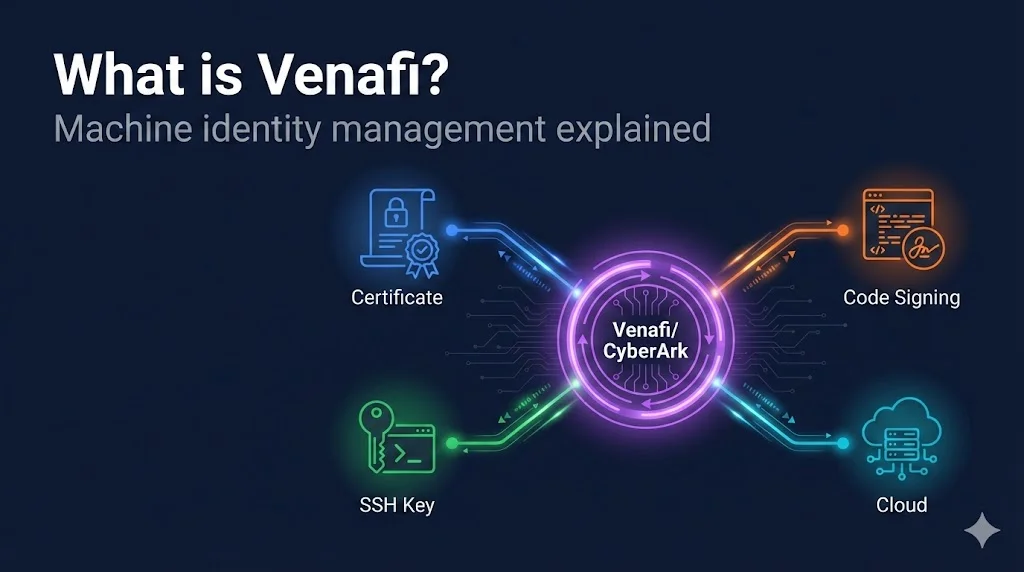
The 60-Second Explanation
Venafi is the enterprise platform for managing machine identities — TLS certificates, SSH keys, and code-signing keys — at scale. As of 2026 it's no longer a standalone company: CyberArk acquired Venafi in October 2024 for $1.54B, renamed its flagship TLS Protect to CyberArk Certificate Manager, and then Palo Alto Networks completed its acquisition of CyberArk on February 11, 2026. The platform, its capabilities, and most of its install base are unchanged — practitioners still call it "Venafi." Here's what it does, what it costs, and whether you need it.
What Venafi Products Are Called Now
If you're searching CyberArk's docs for a Venafi product, use this mapping (per CyberArk's official rebranding notes):
| Old Venafi name | Current name |
|---|---|
| TLS Protect | CyberArk Certificate Manager |
| TLS Protect for Kubernetes | CyberArk Certificate Manager for Kubernetes |
| CodeSign Protect | CyberArk Code Sign Manager |
| SSH Protect | CyberArk SSH Manager for Machines |
| Zero Touch PKI | CyberArk Zero Touch PKI |
Open-source components (cert-manager, Approver Policy, CSI Driver) keep their names. Note: some coverage refers to a further rebrand of CyberArk under Palo Alto — treat post-acquisition naming as in flux and verify against docs.cyberark.com before citing product names in procurement docs.
Think of it as "Active Directory for machines." Just as AD manages human identities (usernames, passwords, access), Venafi manages machine identities (certificates, keys, secrets).
The Core Problem It Solves
Large organizations have thousands to millions of certificates. Without a platform like Venafi, they're tracked in spreadsheets (if at all), renewed manually (or forgotten), and discovered only when something breaks at 2 AM.
What Venafi Provides
Discovery
Find all certificates across your infrastructure
Inventory
Central database of what exists and where
Lifecycle Management
Automate renewal, deployment, revocation
Policy Enforcement
Ensure certificates meet security standards
Visibility
Dashboard showing certificate health, expiration, compliance
Without Venafi
- Spreadsheets
- Manual renewal
- Discovery = outages
- No visibility
- Compliance? Maybe
With Venafi
- Central inventory
- Automated lifecycle
- Continuous discovery
- Real-time dashboard
- Policy enforcement
The Ownership Journey
| Year | Event |
|---|---|
| 2004 | Venafi founded in Salt Lake City, Utah |
| 2010s | Pioneered "machine identity management" category |
| 2020 | Acquired by Thoma Bravo (private equity) |
| May 2024 | CyberArk announces acquisition for $1.54B |
| Oct 2024 | CyberArk acquisition completed |
| 2025 | Venafi products renamed under CyberArk (TLS Protect → CyberArk Certificate Manager) |
| Jul 2025 | Palo Alto Networks announces intent to acquire CyberArk (~$25B headline value) |
| Nov 2025 | CyberArk shareholders approve (99.8%) |
| Feb 11, 2026 | Palo Alto Networks completes the acquisition (total consideration ~$21.1B per PANW's 10-Q). Venafi's third owner in under two years: Thoma Bravo → CyberArk → Palo Alto Networks |
Why CyberArk Bought Venafi
CyberArk is the leader in privileged access management (PAM) — securing human identities with admin access. But machine identities now outnumber human identities 45:1. Acquiring Venafi lets CyberArk secure both.
What This Means for Users
- Existing Venafi customers continue using the platform
- Product now integrated with CyberArk identity suite
- Brand transitioning to "CyberArk Machine Identity Security"
- Documentation and support now through CyberArk
Core Components
Trust Protection Platform (TPP)
The main on-premises platform. Components include:
| Component | What It Does |
|---|---|
| WebSDK | API for automation and integration |
| Aperture | Cloud-based certificate visibility |
| CodeSign Protect | Secure code signing workflows — see the CodeSign Protect deep dive |
| SSH Protect | SSH key management |
| Policy Engine | Certificate policy enforcement |
| Discovery Engine | Network scanning for certificates |
| Venafi Agent | Installed on servers for onboard discovery |
Deployment Models
On-Premises
TPP in your data center
Best for: Regulated industries, air-gapped environments
SaaS
Venafi as a Service (cloud-hosted)
Best for: Faster deployment, less infrastructure
Hybrid
On-prem + cloud visibility
Best for: Large enterprises, multi-cloud
Who Uses Venafi?
Venafi Is For You If...
- Large enterprise (5,000+ employees)
- Thousands of certificates across infrastructure
- Compliance requirements (PCI, HIPAA, SOX)
- Multiple CAs and complex infrastructure
- Previous outages from expired certificates
Probably NOT For You If...
- Small business with <100 certificates
- Using only Let's Encrypt (built-in automation)
- No compliance requirements
- Budget under $50K/year for CLM
The Honest Truth
Venafi (and competitors like Keyfactor, AppViewX) solve real problems at scale. But they're expensive, complex to implement, and require organizational commitment. Buying the tool doesn't magically fix your certificate problems — you need process and people too.
Problems Venafi Solves
Problem 1: Discovery
"How many certificates do we have?"
"I don't know. Maybe 5,000? Could be 50,000."
Venafi scans networks, cloud environments, and servers to find every certificate — including the ones nobody remembers deploying.
Problem 2: Expiration
"Our website went down because a certificate expired"
"Nobody knew it was expiring"
Venafi tracks expiration dates and can automatically renew before outage.
Problem 3: Compliance
"The auditors want proof we're using approved algorithms"
"Let me check those 10,000 spreadsheet rows..."
Venafi enforces policies and provides compliance reporting.
Problem 4: Provisioning
"It takes 3 weeks to get a new certificate deployed"
"We have tickets, approvals, manual steps..."
Venafi automates the request → approval → issuance → deployment workflow.
Problem 5: Visibility
"Are all our certificates using SHA-256? TLS 1.2+? Valid chains?"
"We'd have to check each one manually"
Venafi provides dashboards showing certificate health across the organization.
The Reality Check
From someone who's implemented this at major organizations...
The Automation Promise vs Reality
"Venafi will automate your entire certificate lifecycle!"
The reality: Venafi CAN automate 60-70% of certificate operations in a well-architected environment. The remaining 30-40% involves:
- Legacy systems without API/agent support
- Application owners who don't respond to tickets
- Change management approvals that require humans
- Testing that "did the app actually start?"
- Political battles over who owns what
The Pyramid of Prerequisites
Most organizations try to buy the top of the pyramid without building the foundation.
💡 Honest Assessment
If you're considering Venafi, first ask: Do we have someone whose job is certificate management? If not, buying software won't help. You need process and people before platform. And if you need discovery and mass-revocation tooling without a six-figure platform, start with the FixMyCert Cert Automation Toolkit.
Alternatives & Competitors
| Platform | Strengths | Considerations |
|---|---|---|
| Venafi (CyberArk) | Market leader, deep features, enterprise scale | Complex, expensive, requires expertise |
| Keyfactor | Modern UI, EJBCA integration, good APIs | Growing enterprise presence |
| AppViewX | Multi-cloud focus, modern architecture | Newer to market |
| DigiCert CertCentral | Good if DigiCert is your CA | Vendor lock-in concerns |
| Sectigo Certificate Manager | Affordable, growing features | Less enterprise scale |
| HashiCorp Vault | Secrets + PKI, developer-friendly | Requires technical expertise |
| Let's Encrypt + cert-manager | Free, automated, cloud-native | Public certs only, no enterprise features |
How to Choose
- 1Scale — How many certificates? Venafi/Keyfactor for 10,000+
- 2Environment — Cloud-native? On-prem? Hybrid?
- 3Budget — Enterprise platforms start at $50K+/year
- 4Existing relationships — Which CAs do you use?
- 5Integration needs — What do you need to connect to?
Getting Started
Before the POC
- 1Inventory what you know — Even a rough count helps
- 2Identify stakeholders — Who owns certificates today?
- 3Define success — What problem are you solving first?
- 4Assess infrastructure — Where are certificates deployed?
- 5Plan for resources — Who will implement and operate?
During Evaluation
- Request network discovery scan of representative environment
- Test integration with your primary CA
- Evaluate agent deployment complexity
- Review reporting and compliance features
- Ask about professional services and training
Questions to Ask
- What's the typical implementation timeline?
- How many certificates can the platform discover in our environment?
- What integrations exist for our CAs and infrastructure?
- What ongoing resources are needed to operate the platform?
- How does pricing scale as we add more certificates?
Frequently Asked Questions
Is Venafi still called Venafi?
No. The flagship platform is now CyberArk Certificate Manager (renamed from Venafi TLS Protect in 2025), and CyberArk itself has been part of Palo Alto Networks since February 11, 2026. In practice, nearly every practitioner and job posting still says "Venafi" — expect the old name to persist in the field for years.
Who actually owns Venafi now?
Palo Alto Networks, as of February 11, 2026, via its acquisition of CyberArk. The chain: Venafi founded 2004 → Thoma Bravo (2020) → CyberArk (Oct 2024, $1.54B) → Palo Alto Networks (Feb 2026). Three owners in about two years. For day-to-day users nothing structural has changed yet: support, docs, and licensing run through CyberArk channels.
Does the Palo Alto acquisition change my Venafi deployment?
Not immediately. Certificate Manager (TPP/SaaS) deployments, agents, and CA integrations continue working; contracts and support carry over through CyberArk. The practical risks to watch are the usual post-acquisition ones: roadmap re-prioritization, sales-channel churn, and eventual console/branding migrations. If you're mid-POC, get multi-year pricing locked in writing — vendor pricing is most negotiable during ownership transitions.
How much does Venafi cost?
Enterprise CLM platforms like Venafi typically start at $50,000-$100,000/year and can exceed $500,000/year for large deployments. Pricing depends on certificate count, features, and deployment model. Always request a custom quote.
Can Venafi replace our CA?
No. Venafi is a Certificate Lifecycle Management (CLM) platform, not a Certificate Authority. It integrates with CAs (DigiCert, Let's Encrypt, Microsoft ADCS, etc.) to automate the request, issuance, and deployment process. You still need a CA to issue certificates.
How long does Venafi implementation take?
Typical enterprise implementations take 3-12 months. Phase 1 (discovery and inventory) can be completed in weeks. Full automation with multiple CA integrations and application deployments takes significantly longer. Plan for a multi-phase rollout.
Do I need Venafi for Let's Encrypt automation?
Not usually. Let's Encrypt has built-in automation via ACME, and tools like Certbot and cert-manager handle the lifecycle automatically. Venafi adds value when you need centralized visibility across multiple CAs, compliance reporting, or managing certificates that can't use ACME.