RSA Encryption: The Math Inside Every Certificate
RSA is the algorithm behind the key pair in every X.509 certificate. This guide opens the black box — no math degree required.
Watch: RSA Encryption Explained
RSA is the algorithm behind the key pair in every X.509 certificate. When you generate a CSR, the public key embedded in it is an RSA public key. When your server decrypts a TLS pre-master secret, it uses RSA. When a CA signs your certificate, it uses RSA.
Most PKI documentation skips the math entirely, leaving engineers with a black box they're expected to trust. This guide opens the box.
You do not need a mathematics background. You need to be comfortable with the idea that computers do arithmetic very quickly — and that some arithmetic problems are easy in one direction and practically impossible in reverse.
The One-Way Problem
RSA security comes from a single mathematical asymmetry:
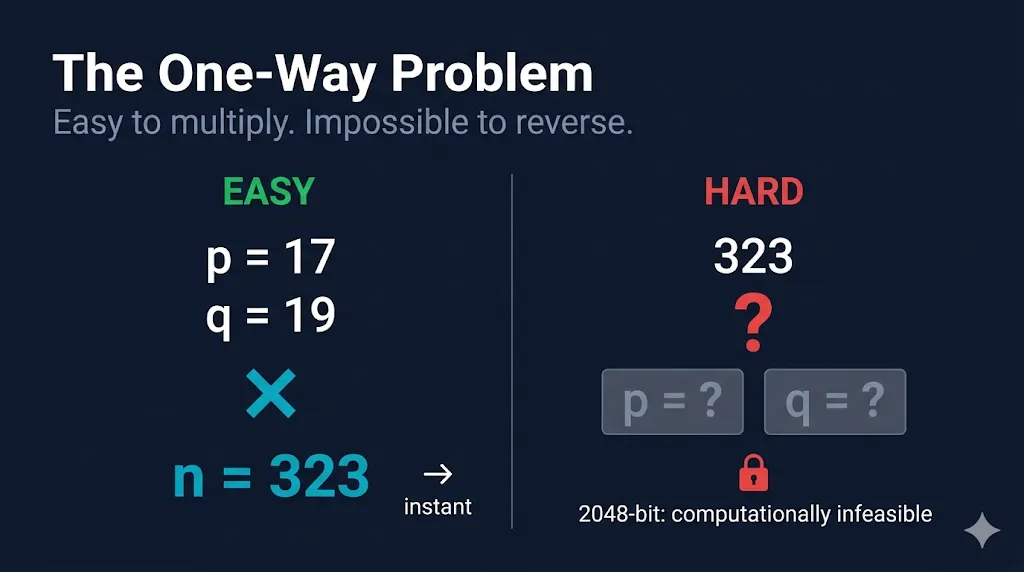
Multiplying two large prime numbers together is trivially easy. Determining which two primes produced a given result is computationally infeasible at production key sizes.
Here is the simplest possible illustration:
17 × 19 = 323
Given only 323, could you find 17 and 19? Yes — in seconds. Now consider two prime numbers each 300 digits long. Their product is a 600-digit number. Finding the original primes from that product would take longer than the current age of the universe, even using the world's fastest supercomputers.
This is called the integer factorization problem, and it is the entire security foundation of RSA.
Key Generation
Generating an RSA key pair follows five steps. These steps happen when you run openssl genrsa, when your HSM creates a key pair, or when a CA initializes its root key.
Step 1 — Choose two large primes: p and q
In production, these are generated by a cryptographically secure random number generator (CSPRNG). They are typically 1024–2048 bits each, producing a combined modulus of 2048–4096 bits. The randomness of this step is critical — predictable primes have led to real-world key compromise in embedded devices.
Step 2 — Compute the modulus: n = p × q
n is the public modulus. It appears in both your public key and private key. For a 2048-bit RSA key, n is a 2048-bit number.
Step 3 — Compute Euler's totient: φ(n) = (p−1)(q−1)
φ(n) counts how many integers less than n are coprime to n. This value is used to derive the private exponent and is kept secret. Once n is published, φ(n) can only be computed by someone who knows p and q — which is why factoring n would break RSA.
Step 4 — Choose the public exponent: e
e must be coprime to φ(n). In practice, e = 65537 is used almost universally. It is prime, coprime to any valid φ(n), and its binary representation (10000000000000001) allows efficient modular exponentiation.
Step 5 — Compute the private exponent: d
d is the modular multiplicative inverse of e with respect to φ(n):
e × d ≡ 1 (mod φ(n))
This is computed using the Extended Euclidean Algorithm. The result d is your private key exponent.
The result:
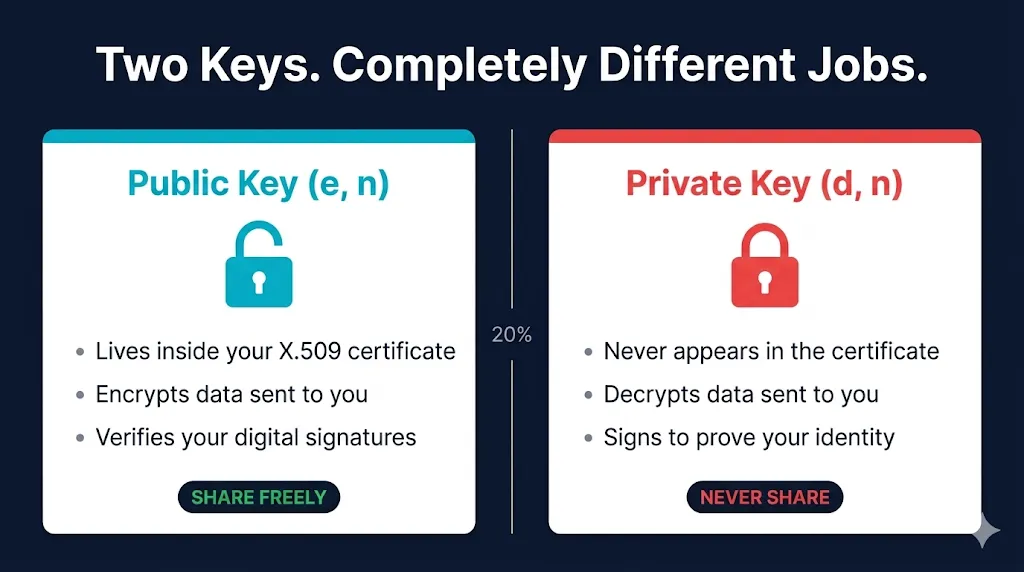
Public Key: (e, n) → embedded in your X.509 certificate's Subject Public Key Info
Private Key: (d, n) → stored in your private key file or HSM; never leaves the server
p, q, and φ(n) must be destroyed after key generation or stored with the same security as the private key. Anyone who recovers these values can reconstruct d and compromise the key.Encryption and Decryption
With a key pair generated, the encrypt/decrypt operations are compact:
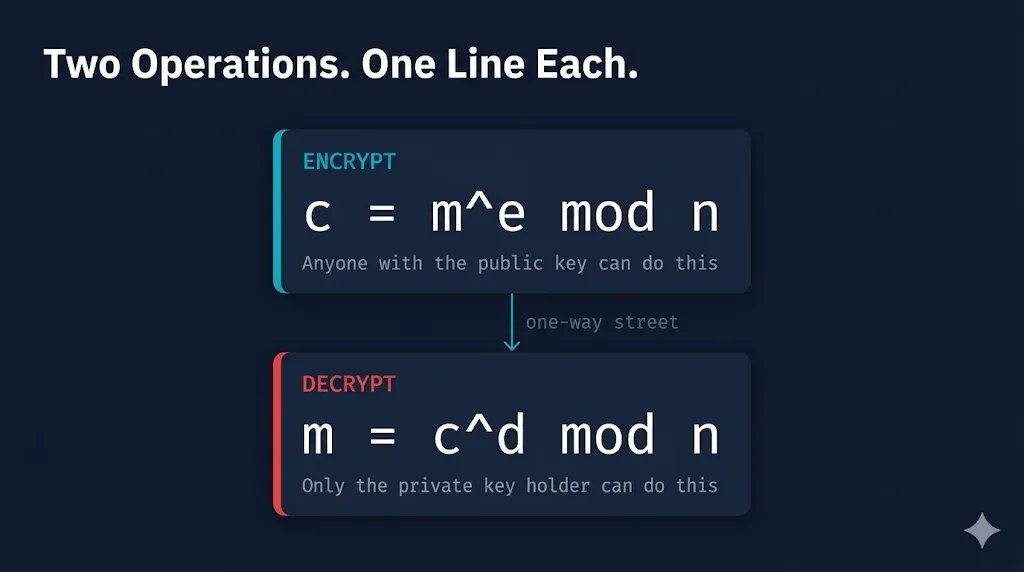
Encryption (anyone with the public key can perform this)
c = m^e mod n
Where m is the message (represented as an integer), e is the public exponent, and n is the modulus. The result c is the ciphertext.
Decryption (only the private key holder can perform this)
m = c^d mod n
Where c is the ciphertext, d is the private exponent, and n is the modulus. The result is the original message m.
The mod operation (modulo) returns the remainder after integer division. It is what makes this computation one-directional without d.
Why does this work?
Euler's theorem guarantees that for any m and the key pair (e, d, n):
m^(e×d) ≡ m (mod n)
Because e × d ≡ 1 (mod φ(n)) by construction, encrypting and then decrypting always returns the original value. The mathematical proof relies on the Chinese Remainder Theorem and is covered in any number theory textbook.
RSA in Your PKI Stack
X.509 Certificates
The public key (e, n) is stored in the Subject Public Key Info (SPKI) extension of your X.509 certificate. When you inspect a certificate:
openssl x509 -in cert.pem -text -noout | grep -A 10 "Public Key"
You will see the public exponent (e, almost always 65537) and the public modulus (n). The private key (d, n) is never in the certificate — it lives in a separate file (key.pem) or inside your HSM.
TLS Handshake (TLS 1.2)
In a TLS 1.2 handshake using RSA key exchange:
- The server sends its X.509 certificate (containing the public key)
- The client verifies the certificate chain using the CA's public key
- The client generates a random pre-master secret
- The client encrypts the pre-master secret using the server's public key:
c = m^e mod n - The server decrypts it using the private key:
m = c^d mod n - Both sides independently derive the session keys from the pre-master secret
- The encrypted session begins
Digital Signatures
RSA is also used for signing, which works in reverse:
signature = hash(data)^d mod n    ← private key signs
verified  = signature^e mod n     ← public key verifies
The CA uses its private key to sign your certificate. Clients verify that signature using the CA's public key (embedded in the trusted root or intermediate cert). This is how the certificate chain is validated.
Key Ceremonies
The most sensitive RSA operation is not encryption or decryption — it is prime generation. Generating p and q for a CA root key is a high-security event because:
- The security of every certificate the CA ever issues depends on
pandqremaining secret - The operation cannot be repeated without issuing a new root and re-establishing trust
- Regulators require it to be witnessed, audited, and documented
A formal Key Ceremony controls this process: offline hardware, multiple trusted witnesses, roles assigned in advance, and an auditable record of every action. This is a requirement for WebTrust and ETSI certification.
What Can Go Wrong
Weak or predictable prime generation
If the CSPRNG used to generate p and q is seeded poorly, primes can be predicted or repeated across devices. In 2012, researchers factored a significant percentage of public RSA keys collected from the internet by exploiting shared prime factors — keys that had been generated on devices with insufficient entropy at boot time. Use a properly seeded CSPRNG. Use an HSM if generating CA keys.
Private key exposure
d is exposed, every message ever encrypted with the corresponding public key can be decrypted, and the attacker can forge signatures. There is no partial mitigation. Revoke the certificate, rotate the key, and investigate how the exposure occurred.Missing or incorrect padding
Textbook RSA (as shown in this guide) is not directly used in production. Raw RSA without padding is vulnerable to several attacks. In practice:
- PKCS#1 v1.5 padding is used for backwards compatibility (but has known vulnerabilities — ROBOT attack)
- OAEP (Optimal Asymmetric Encryption Padding) is the current standard for encryption
- PSS (Probabilistic Signature Scheme) is the standard for signing
If you are implementing RSA in code, use a well-maintained cryptographic library and let it handle padding. Do not implement raw RSA.
Key size below 2048 bits
1024-bit RSA keys are considered broken by modern standards. NIST deprecated them in 2013. Most CAs no longer issue certificates with 1024-bit public keys. Use 2048-bit as a minimum; 4096-bit for long-lived CA keys.
The quantum horizon
Shor's algorithm, running on a fault-tolerant quantum computer, would solve the integer factorization problem efficiently — breaking RSA entirely. This is not an immediate threat; fault-tolerant quantum computers at the required scale do not yet exist. However, NIST published its first post-quantum cryptography (PQC) standards in 2024. If you are designing a PKI with a 10–20 year lifespan, PQC migration planning is worth including in your roadmap.
Key Takeaways
- RSA security is grounded in the integer factorization problem — multiplying primes is easy, factoring the product back is not
(e, n)is your public key; it lives in your certificate.(d, n)is your private key; it never leaves the server- In TLS 1.2, RSA encrypts the pre-master secret. In TLS 1.3, ECDHE handles key exchange; RSA still signs the certificate chain
- Digital signatures use the private key to sign and the public key to verify — the inverse of encryption
- Key ceremonies exist to protect prime generation, the most sensitive step in PKI operations
- Always use OAEP padding for encryption and PSS for signing. Do not implement raw RSA
- Minimum key size is 2048 bits. Use 4096 bits for long-lived CA keys
- Begin tracking NIST PQC standards if your PKI has a long operational horizon
See RSA in action
Type a message and watch modular arithmetic encrypt and decrypt it step by step