Symmetric vs Asymmetric Encryption
Understand the two fundamental types of encryption that protect all modern digital communications. Learn when to use each type, how they work together in TLS, and see practical examples.
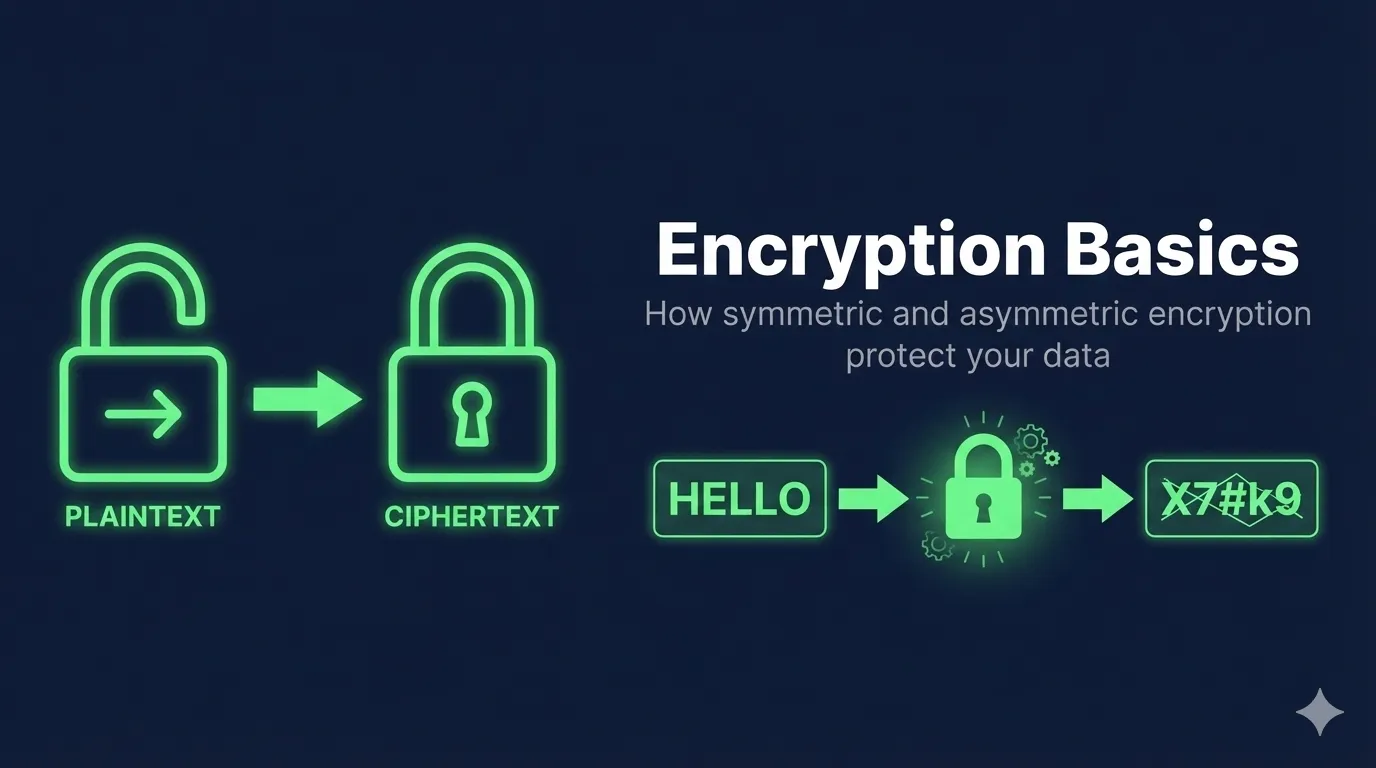
Quick Answer: Symmetric vs Asymmetric
Symmetric Encryption
Uses one shared key for both encryption and decryption. Fast and efficient, but requires secure key exchange.
Examples: AES, ChaCha20, 3DES
Asymmetric Encryption
Uses a key pair: public key to encrypt, private key to decrypt. Solves key distribution but slower.
Examples: RSA, ECDSA, Ed25519
💡 Key Insight: Modern protocols like TLS use both types together. Asymmetric encryption establishes a secure channel, then symmetric encryption handles the fast data transfer.
SYMMETRIC ENCRYPTION
"One Key"
ASYMMETRIC ENCRYPTION
"Key Pair"
Symmetric Encryption Explained
Symmetric encryption uses a single secret key for both encrypting and decrypting data. Think of it like a lockbox where the same key locks and unlocks the contents.
How It Works
- 1. Alice and Bob agree on a shared secret key
- 2. Alice encrypts the message using the shared key
- 3. Alice sends the encrypted message (ciphertext) to Bob
- 4. Bob decrypts using the same shared key
Advantages
- ✓ Speed: 100-1000x faster than asymmetric encryption
- ✓ Efficiency: Lower computational overhead, ideal for large data
- ✓ Small keys: 128-256 bit keys provide excellent security
Disadvantages
- ✗ Key distribution problem: How do you securely share the key?
- ✗ Scalability: Need unique keys for every pair of communicators
- ✗ No authentication: Can't prove who sent the message
The Key Distribution Problem
Alice wants to send encrypted message to Bob...
"How do I send the key safely?"
Sending key over insecure channel:
Asymmetric solves this:
Alice encrypts with Bob's public key
Asymmetric Encryption Explained
Asymmetric encryption uses a mathematically linked key pair: a public key that anyone can see and a private key that must remain secret.
How It Works
- 1. Bob generates a key pair (public + private)
- 2. Bob shares his public key openly
- 3. Alice encrypts message with Bob's public key
- 4. Only Bob's private key can decrypt it
The Key Insight
Public key = encrypt only. Anyone can lock a message for Bob.
Private key = decrypt only. Only Bob can unlock messages meant for him.
Even if an attacker has the public key, they cannot derive the private key.
Advantages
- ✓ Solves key distribution: Public keys can be shared openly
- ✓ Digital signatures: Prove identity and message integrity
- ✓ Scalability: One key pair works with unlimited parties
Disadvantages
- ✗ Slow: ~1000x slower than symmetric encryption
- ✗ Large keys: RSA needs 2048-4096 bit keys for security
- ✗ Message size limits: Can only encrypt small amounts of data directly
Key Differences Comparison
Security Properties: Encryption provides confidentiality (keeping data secret). Combined with other techniques, you can also achieve integrity (detecting tampering) andauthenticity (proving who sent the message). Symmetric encryption alone only provides confidentiality, while asymmetric cryptography enables all three through digital signatures.
| Feature | Symmetric | Asymmetric |
|---|---|---|
| Keys Used | 1 shared key | 2 keys (public + private) |
| Key Length | 128-256 bits | 2048-4096 bits (RSA) |
| Speed | Very fast | Slow |
| Key Distribution | Difficult | Easy (public key) |
| Digital Signatures | Not possible | Supported |
| Use Case | Bulk data encryption | Key exchange, signatures |
Encryption Speed Comparison
Operations per second (logarithmic scale)
Symmetric encryption is ~1000x faster for bulk data encryption. That's why TLS uses asymmetric only for key exchange, then switches to symmetric for actual data.
Note: Performance figures are approximate and vary by hardware. These illustrate relative magnitude, not exact benchmarks.
Common Algorithms
Symmetric Algorithms
| Algorithm | Key Size | Status | Use Case |
|---|---|---|---|
| AES-256 | 256 bits | ✅ Recommended | TLS, disk encryption |
| AES-128 | 128 bits | ✅ Secure | General purpose |
| ChaCha20 | 256 bits | ✅ Modern | Mobile, TLS 1.3 |
| 3DES | 168 bits | ❌ Deprecated | Legacy systems only |
Asymmetric Algorithms
| Algorithm | Key Size | Status | Use Case |
|---|---|---|---|
| RSA-2048 | 2048 bits | ✅ Standard | TLS, code signing |
| ECDSA P-256 | 256 bits | ✅ Recommended | TLS, certificates |
| Ed25519 | 256 bits | ✅ Modern | SSH, signatures |
| X25519 | 256 bits | ✅ Modern | TLS key exchange |
How TLS Uses Both
TLS (Transport Layer Security) solves the speed vs security tradeoff by using asymmetric encryption for the handshake and symmetric encryption for data transfer.
TLS 1.3 Connection Timeline
How modern TLS uses both encryption types
Best of both worlds - asymmetric security with symmetric speed
The TLS Hybrid Approach
Asymmetric Key Exchange
Client and server use asymmetric encryption (or Diffie-Hellman) to securely agree on a shared secret. This happens during the TLS handshake.
Session Key Derivation
Both sides derive symmetric session keys from the shared secret. These keys are unique to this connection.
Symmetric Data Encryption
All application data is encrypted with AES or ChaCha20 using the session keys. Fast and efficient for gigabytes of data.
# Simplified TLS 1.3 Handshake Flow:

Client → Server:  ClientHello (supported ciphers, key share)
Server → Client:  ServerHello (selected cipher, key share, certificate)

# Both compute shared secret using ECDHE
# Derive symmetric session keys

Client → Server:  Finished (encrypted with session key)
Server → Client:  Finished (encrypted with session key)

# All subsequent data uses AES-256-GCM symmetric encryption
💡 Why this matters: A single HTTPS connection might exchange megabytes of data. Encrypting all of it with RSA would be impossibly slow. By using RSA or ECDHE only for the initial key exchange, TLS gets the security benefits of asymmetric crypto with the speed of symmetric encryption.
Practical Examples with OpenSSL
Symmetric Encryption with AES
# Encrypt a file with AES-256-CBC
openssl enc -aes-256-cbc -salt -in secret.txt -out secret.enc -pass pass:mypassword

# Decrypt the file
openssl enc -d -aes-256-cbc -in secret.enc -out secret.txt -pass pass:mypassword

# Using AES-256-GCM (authenticated encryption)
openssl enc -aes-256-gcm -in secret.txt -out secret.enc -pass pass:mypassword
Asymmetric Encryption with RSA
# Generate RSA key pair
openssl genrsa -out private.key 2048
openssl rsa -in private.key -pubout -out public.key

# Encrypt with public key (anyone can do this)
openssl pkeyutl -encrypt -pubin -inkey public.key -in message.txt -out message.enc

# Decrypt with private key (only key owner)
openssl pkeyutl -decrypt -inkey private.key -in message.enc -out message.txt
Note: RSA can only encrypt data smaller than the key size minus padding. For larger files, encrypt with AES and then encrypt the AES key with RSA (hybrid encryption).
When to Use Each Type
Use Symmetric When:
- → Encrypting large files or databases
- → Real-time communications (after key exchange)
- → Disk/file system encryption
- → Both parties already share a secret
- → Performance is critical
Use Asymmetric When:
- → Establishing secure channels (key exchange)
- → Digital signatures and authentication
- → Certificate-based identity verification
- → Parties have never communicated before
- → Non-repudiation is required
Which Encryption Type Should You Use?
Follow the decision tree
Use both together, like TLS does
When in doubt, use the hybrid approach: asymmetric for key exchange, symmetric for data.
Related Resources
Key Exchange Algorithms
Learn how Diffie-Hellman and ECDHE enable secure key exchange between parties.
Hash Functions
Understand SHA-256, SHA-3, and why cryptographic hashing matters for integrity.
How TLS Works
See how encryption is applied in real-world HTTPS connections.
Digital Signatures
How asymmetric encryption powers authentication and non-repudiation.
RSA vs ECC
Compare the two main asymmetric algorithms used in modern PKI.
Cipher Suite Decoder
Interactive tool to decode and understand TLS cipher suite strings.
Frequently Asked Questions
Why not always use asymmetric encryption?
Asymmetric encryption is about 1000x slower than symmetric encryption and can only encrypt small amounts of data (limited by key size). For bulk data transfer, it would be impractically slow.
Is AES-128 still secure?
Yes, AES-128 is still considered secure and approved for use. However, AES-256 is often preferred for long-term security and compliance requirements (HIPAA, PCI-DSS).
What happens if I lose my private key?
For encryption: Any data encrypted with the corresponding public key cannot be decrypted. For TLS certificates: You'll need to generate a new key pair and get a new certificate.
What is "authenticated encryption"?
Authenticated encryption (like AES-GCM) provides both confidentiality AND integrity verification. It ensures data hasn't been tampered with, not just that it's encrypted. Modern TLS always uses authenticated encryption.
Will quantum computers break all encryption?
Quantum computers threaten asymmetric algorithms (RSA, ECDSA) via Shor's algorithm. Symmetric algorithms like AES are more resistant—AES-256 would still provide 128-bit security against quantum attacks. Post-quantum cryptography standards are being developed.
Ready to See It in Action?
Watch symmetric and asymmetric encryption step-by-step in our interactive demo.
Try the Interactive Demo