The 30-Second Version
A Certificate Practice Statement (CPS) is a public document that describes exactly how a Certificate Authority operates: how they verify identities, issue certificates, handle revocation, and protect their infrastructure. Every public CA is required to publish one. You've probably never read yours. After Entrust, maybe you should.
But here's what most people miss: CPS documents aren't just for public CAs. If your organization runs any internal Certificate Authority — Microsoft ADCS, EJBCA, AWS Private CA, or anything else — you should have one too.
Watch the Video
What is a CPS?
A Certificate Practice Statement is a detailed document that describes:
- Howa CA verifies certificate requests
- Whatprocedures they follow for issuance
- Whenand how they revoke certificates
- Wherethey store keys and how they protect them
- Whois responsible for what
Think of it as the CA's operating manual—made public so anyone can verify they're following the rules.
CPS vs Certificate Policy (CP)
These terms get confused constantly. Here's the difference:
| Document | What It Answers | Who Writes It | Analogy |
|---|---|---|---|
| Certificate Policy (CP) | "What are the rules?" | CA/Browser Forum, root programs, or your organization | The law |
| Certificate Practice Statement (CPS) | "How do we follow the rules?" | Each individual CA (public or private) | How we comply |
Example:
- CP (Baseline Requirements): "CAs must revoke compromised certificates within 24 hours"
- CPS (Sectigo): "Sectigo will revoke within 24 hours using our internal ticketing system, verified by two operators..."
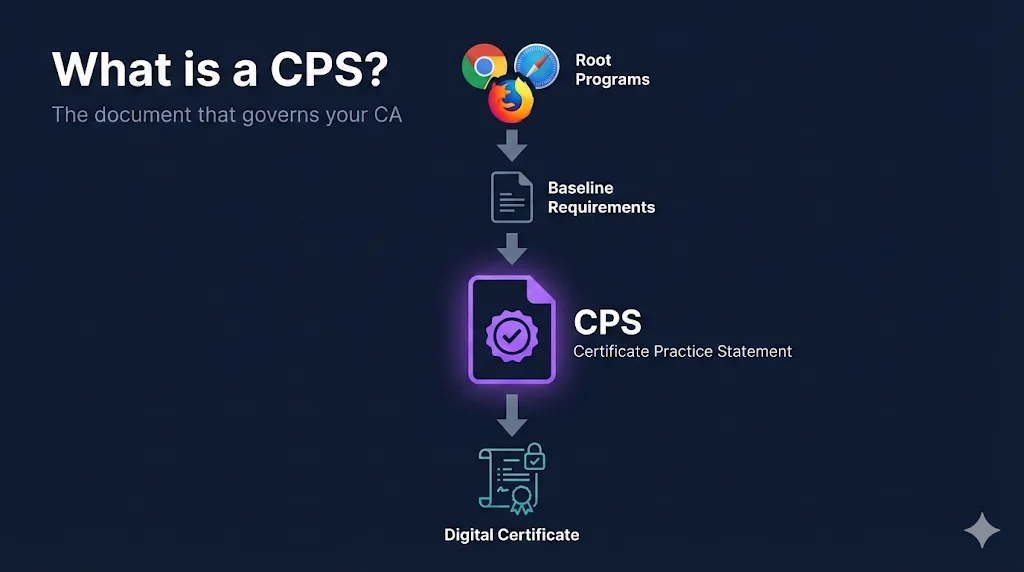
The CP sets requirements. The CPS explains how a specific CA meets those requirements.
Does Your Organization Need a CPS?
Most people assume CPS documents are only for public CAs like DigiCert or Let's Encrypt. That's wrong. If your organization operates any Certificate Authority — including internal ones — you should have a CP/CPS.
Who Needs CP/CPS Documentation
Enterprise PKI operators
If you're running Microsoft ADCS, EJBCA, or any private CA, you're issuing certificates that people and systems rely on. Without documented policies, there's no governance, no accountability, and no audit trail.
Organizations seeking compliance certifications
WebTrust, ETSI, SOC 2, and ISO 27001 auditors all expect documented certificate policies. Walking into an audit without a CP/CPS is walking in unprepared.
Federal agencies and government contractors
The Federal PKI requires CPS documentation that describes how each CP requirement is fulfilled. NIST SP 800-57 Part 2 explicitly states that any organization employing cryptography needs key management policy and practices documentation.
Healthcare organizations
HIPAA doesn't specifically mandate a CPS, but if you're using certificates for authentication, encryption, or digital signatures in healthcare systems, documented practices are expected during security audits.
Financial services
PCI DSS and banking regulators expect documented controls around cryptographic key management. Your internal CA's CPS is where those controls live.
IoT manufacturers
If you're issuing device certificates at scale, documented issuance, revocation, and key management procedures aren't optional — they're how you demonstrate your supply chain is trustworthy.
The Numbers Tell the Story
The gap between "should have PKI governance" and "actually has it" is staggering:
of organizations either have no strategy for managing cryptography and machine identities (18%) or only a limited strategy applied to certain use cases (42%)
of organizations don't know how many keys and certificates they have
of organizations say digital certificates have caused unanticipated downtime or outages
organizations report having a mature cryptographic center of excellence to support enterprise-wide strategy
have sufficient staff dedicated to PKI deployment
internally trusted certificates managed by the average organization
Sources: Keyfactor/Ponemon Institute (2019, 2021), Keyfactor 2024 PKI & Digital Trust Report
Microsoft's own PKI documentation confirms the problem, acknowledging that it is "quite common to delay creating a CP/CPS until after some CAs are already deployed in the environment" and calling out "a common error for organizations during PKI solutions deployment is the lack of PKI governance or oversight."
Even AWS recommends in their Private CA best practices that organizations document their CA operations in CP and CPS documents following the RFC 3647 framework.
Ready to fix your PKI governance gap?
Our Compliance-in-a-Box package includes 7 PKI compliance documents — Certificate Policy & Certificate Practice Statement template, Key Ceremony Script, PCI/DORA/NIS2 Compliance Crosswalk, and more — all structured per RFC 3647 and ready to customize for your organization. Stop going into audits empty-handed.
The RFC 3647 Framework
All CPS documents follow the same structure, defined by RFC 3647. This makes them comparable across CAs — whether public or private, cloud-hosted or on-premises.
| Section | What It Covers | Why You Care |
|---|---|---|
| 1. Introduction | Scope, participants, certificate types | What certificates this CPS covers |
| 2. Publication & Repositories | Where to find CRLs, OCSP, certificates | Troubleshooting revocation issues |
| 3. Identification & Authentication | How they verify you own a domain/org | Understanding validation requirements |
| 4. Certificate Lifecycle ⭐ | Issuance, renewal, revocation procedures | Your rights and obligations |
| 5. Facility & Management Controls | Physical security, personnel | CA's operational security |
| 6. Technical Security Controls | Key management, algorithms, HSMs | Cryptographic standards |
| 7. Certificate & CRL Profiles | What's in the certificates they issue | Technical certificate details |
| 8. Compliance Audit | Who audits them and how often | CA accountability |
| 9. Other Business & Legal | Warranties, liability, disputes | What happens when things go wrong |
Key Sections Every Certificate Buyer Should Read
You don't need to read all 100+ pages. Focus on these:
Section 3.2: Validation Procedures
How does your CA verify domain ownership? Understanding this helps when validation fails.
Common DCV Methods:
- • Email to admin@, webmaster@, hostmaster@, postmaster@
- • DNS TXT record with random value
- • HTTP file at
/.well-known/pki-validation/ - • CNAME record pointing to CA
Section 4.9: Revocation
When can/must your CA revoke your certificate? Key timelines:
| Scenario | Required Timeframe |
|---|---|
| Key compromise | Within 24 hours |
| Certificate obtained by fraud | Within 24 hours |
| CA discovers mis-issuance | Within 24 hours |
| Subscriber requests revocation | Within 24 hours |
| Subscriber breaches agreement | Within 5 days |
| Domain validation no longer valid | Within 5 days |
Section 9.6: Subscriber Obligations
What you agreed to (whether you read it or not):
- • Private key has never been compromised or shared
- • All certificate information is accurate
- • You'll notify CA immediately of any key compromise
- • You won't use the certificate for prohibited purposes
- • You'll stop using it immediately upon revocation or expiration
Section 9.7-9.8: Warranties and Liability
What your CA is (and isn't) responsible for:
CAs typically warrant:
- • Certificate info was verified per their CPS
- • Certificate complies with Baseline Requirements
- • Revocation services will be available
CAs typically DON'T warrant:
- • That your software correctly validates certs
- • That you'll use the certificate properly
- • Anything about your infrastructure
Liability is usually capped at the certificate purchase price or a fixed amount. Don't expect to sue your CA for millions if something goes wrong.
How CPS Relates to CA/Browser Forum Requirements
The hierarchy works like this:
Where to Find Your CA's CPS
Every CA publishes their CPS. Common locations:
| CA | CPS Location |
|---|---|
| DigiCert | digicert.com/legal-repository |
| Sectigo | sectigo.com/legal |
| Let's Encrypt | letsencrypt.org/repository |
| GlobalSign | globalsign.com/repository |
| Entrust | entrust.com/legal-compliance |
| GoDaddy | godaddy.com/legal/agreements |
What Happens When CAs Violate Their CPS
This is where it gets real. CAs that don't follow their CPS (or the Baseline Requirements) face consequences:
Browser Response Options
- Warning - CA must explain and remediate
- Reduced trust - Shorter certificate validity, additional audits
- Partial distrust - New certificates not trusted
- Full distrust - CA removed from root stores
Recent Examples
| CA | Year | What Happened | Consequence |
|---|---|---|---|
| Entrust | 2024 | Pattern of compliance failures, 26K+ mis-issued EV certs | Distrusted by Chrome, Safari, Firefox |
| Symantec | 2017 | Mass mis-issuance, poor controls | Sold PKI business to DigiCert |
| WoSign/StartCom | 2016 | Backdated certificates, lied to auditors | Fully distrusted |
| DigiNotar | 2011 | Hacked, issued fake Google certs | Bankrupt within weeks |
→ See our PKI Disasters Hall of Fame for the full stories
Why This Matters for Your Organization
1. Know Your Obligations
You agreed to subscriber obligations when you bought your certificate. Violating them (even accidentally) gives your CA grounds to revoke.
2. Understand Revocation Risk
Your CA can revoke certificates for compliance reasons with minimal notice. If you're not monitoring, you might not know until users start seeing errors.
3. Evaluate CA Risk
A CA with frequent CCADB incidents is a CA at risk of distrust. Reading their CPS (and watching their incident history) helps you assess this risk.
4. Plan for CA Transitions
Understanding that all CPS documents follow RFC 3647 means switching CAs is easier—the structure is the same, even if details differ.
5. Document Your Own PKI Governance
If you're operating internal CAs, the same RFC 3647 framework that governs public CAs applies to you. The research is clear:
- • 71% of organizations don't know how many certificates they have
- • 56% have experienced outages from certificate expiration or misconfiguration
- • Only 45% have sufficient staff dedicated to PKI
These aren't just numbers — they're symptoms of missing governance. A CP/CPS forces you to answer the hard questions: Who can issue certificates? What happens when a key is compromised? How do you handle revocation?
Ready to fix your PKI governance gap?
Our Compliance-in-a-Box package includes 7 PKI compliance documents — Certificate Policy & Certificate Practice Statement template, Key Ceremony Script, PCI/DORA/NIS2 Compliance Crosswalk, and more — all structured per RFC 3647 and ready to customize for your organization. Whether you're preparing for your first audit or cleaning up years of undocumented PKI, these templates give you a professional starting point.